Annual Planning Process
Annual planning isn't just something you do as a company — you should do it as an individual as well.
For many years, I’ve been developing a routine to take stock as the year ends, and set big goals for the year to come. My process has three components, all of which I recommend sharing with key stakeholders — your coach, peers, board and/or your leadership team — to foster alignment and request accountability.
1. Revisit the job description
I spent fifteen years as a CEO, with one title, and yet, my role, areas of focus, and measures for success evolved consistently. That's one of the great things about the role — it's always forcing you to learn, adapt, and evolve. Eventually, I started revising my job description every year, using a few prompts for inspiration:
- Am I spending time on everything listed in this job description?
- What needs more of my time and focus? What needs less?
- Do my responsibilities align with and contribute to the company's goals next year?
- How do I want my performance to be evaluated?
If you'd like some inspriation, here's a link to the last version of my job description as CEO.
When your job description is finished, does it excite you? Are you pumped to give that role your very best? If not, it's a flag worth exploring further before moving on to the next tactic.
2. Write a growth plan
To borrow words from the great Dolly Parton, “Find out who you are and do it on purpose."
As part of the performance review process, I've always asked everyone in the company to write a growth plan (aka a self-assessment). One of my core beliefs is that writing catalyzes clarity. Yet, writing is often an underutilized tool to analyze performance. Writing a self-assessment gives you an opportunity to reflect, celebrate wins, acknowledge what could be better, and create a plan you can share with teammates.
As CEO, it's critical to model the behavior you want to see from others, so I spent a lot of time writing my own growth plan. In Q4, I typically work with my Coach to run a 360 process, interviewing ~15 people about my performance. It serves as a key input to my growth plan, but it's not a required step for the exercise to be effective.
My growth plan includes three key elements:
- Reflect on the past year. How did you perform relative to the goals you set?
- Reflect on the upcoming year. What new goals are you setting and why?
- Personal growth. What growth is needed from you to be successful as CEO?
I limit my plan to three goals. I like OKRs as a framework for the growth plan, but as long as your goals are measurable, do what works for you. Here's an example goal from one of my previous growth plans:
Objective: Create more thought leadership content.
Key result: Dedicate 30% of my time to GTM/Strategy work.
Focus more time and effort on supporting our new positioning and thought leadership content. I can contribute to this in several ways:
- Post on LinkedIn at least once week.
- Write a blog post once per quarter.
- Partner with the Marketing team to level up the content strategy.
- Participate in customer events, empower the team to do them.
Note that between the job description and the growth plan, each has a distinct purpose. Neither is several pages long — it's 1-2 max. All of the important content is listed as bullets. Make it easy for yourself and others to look back on these documents and get clarity quickly.
3. Analyze your time
Setting intentions with a job description and a growth plan is great, but then things happen, especially as a CEO or C-level leader. Everyone gets busy, and we need consistent accountability to focus on the most important things. That’s where time tracking comes in.
At the beginning of each year, I set up labels and colors in Google Calendar for all the areas I want to track. At the end of every day, I manually go back and fill in non-meeting blocks of time with whatever I worked on. Then, I can leverage the Time Insights feature to analyze how much time I spend in each area.
To take it one step further, my assistant Katie created a sheet with a breakdown we had more control over. Here's an example of how I spent nearly 400 hours over the course of a quarter:
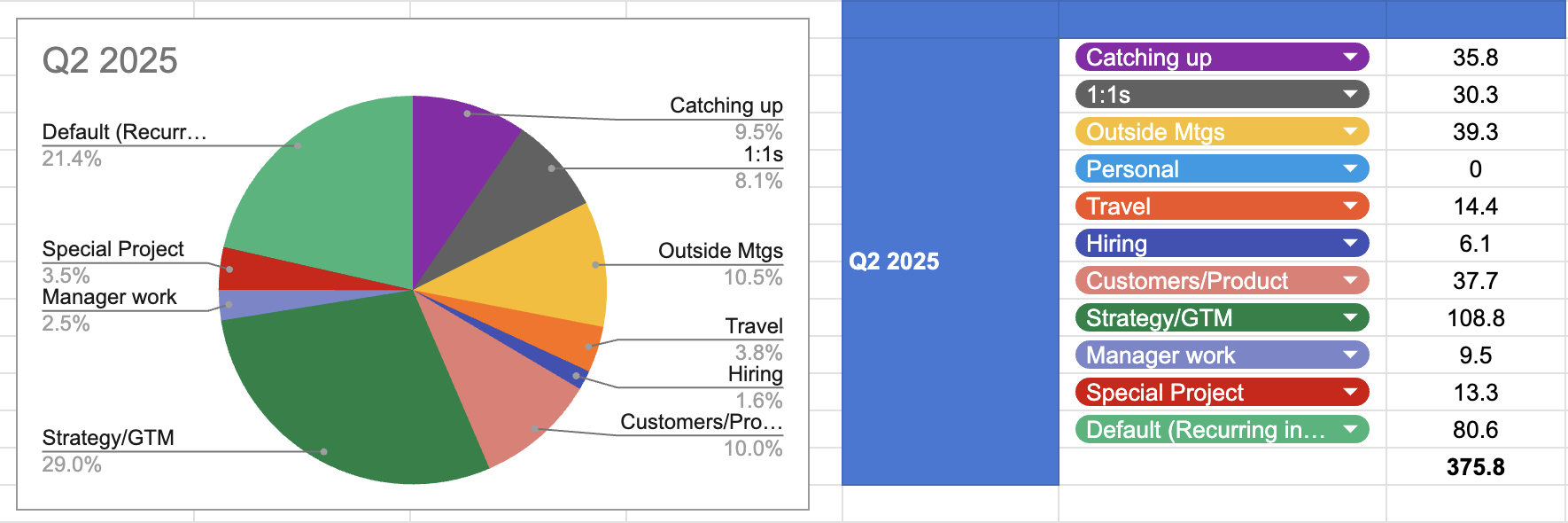
Tracking an analyzing your time will serve as great inputs for your job description and growth plan in future years. Remember, tracking your time doesn't have to be perfect or precise. Just start, do your best, stick to it for 30 days, and it will become a habit. It's a gift to your future self.
For more inspiration on this topic, my friend Seth Sivak wrote a great post on annual self-reviews.